
Building for Cryogenic Techniques
Mössbauer spectroscopy is a nuclear technique that has been developed in CTN (former ITN) for applications in CTN coordinated research on Solid State Science and Earth Sciences. This facility has also been supporting, since its very first steps, research programs from other national or foreign Research Institutes and Universities. This interaction with other institutions has always been performed on the basis of scientific collaboration and formation of young scientists (graduate and post-graduate students) since expert interpretation of the Mössbauer spectra based on the electronic structure of the studied samples is necessary.
Main Equipment
Presently two transmission Mössbauer Spectrometers are available. These spectrometers may be coupled to a continuous-flow liquid-He cryostat or a bath cryostat enabling studies with the absorber in the temperature range 2-300 K. Conversion electron Mössbauer spectra of surface layers, thin films, multilayers, etc. may also be obtained at room temperature. Existing and currently used sources are 57Co and 151Sm for 57Fe and 151Eu Mössbauer spectroscopy, respectively. Other sources such as 119mSn are acquired whenever a research program justifies it.
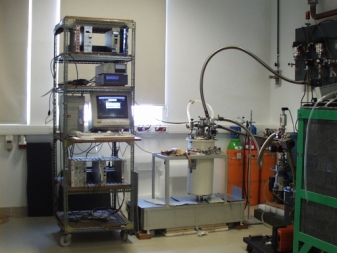
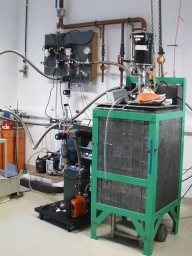
Mössbauer spectroscopy.
Examples of on-going research in Materials Science and Earth Sciences
- Mixed-conducting oxide materials for high-temperature electrochemical devices: electrodes of solid oxide fuel cells, ceramic membranes for partial oxidation of hydrocarbons. Study of the Fe oxidation state and coordination (collaboration with the Univ. of Aveiro).
- Ternary intermetallics of A-Fe-M systems (A=rare-earth, U; M = Al, Si, Ga, Ge, Sn, Sb). Structural characterization and investigation of the magnetic properties of the Fe sublattices (collaboration with Charles University, Prague, Czech Republic and University of Rennes, France).
- Molecule-based magnets. Magnetic properties of Fe (collaboration with the Univ. of Valencia, Spain).
- Mineral chemistry. Oxidation state and distribution of Fe atoms in different crystallographic sites. Applied to the establishment of metallogenetic models for ore-forming systems, alteration mechanisms of rocks used as building materials, characterization of clays for pharmaceutical, medical and cosmetic applications (collaboration with the Fac. Sciences of the Univ. of Lisbon and Centro de Tecnologia Mineral, Rio de Janeiro, Brasil).